Skip to content
Acoustic Pixel
Home cinema · seating

The seats decide the room.
Most people choose them last.

Cinema sofas, recliners, cinema rows and bespoke seating, designed into the room rather than bought as an afterthought. Where the seats sit decides the screen size, the speaker placement and the riser height, so the seating plan is one of the first things we design. This guide covers how to choose well, whether we build your room or not.

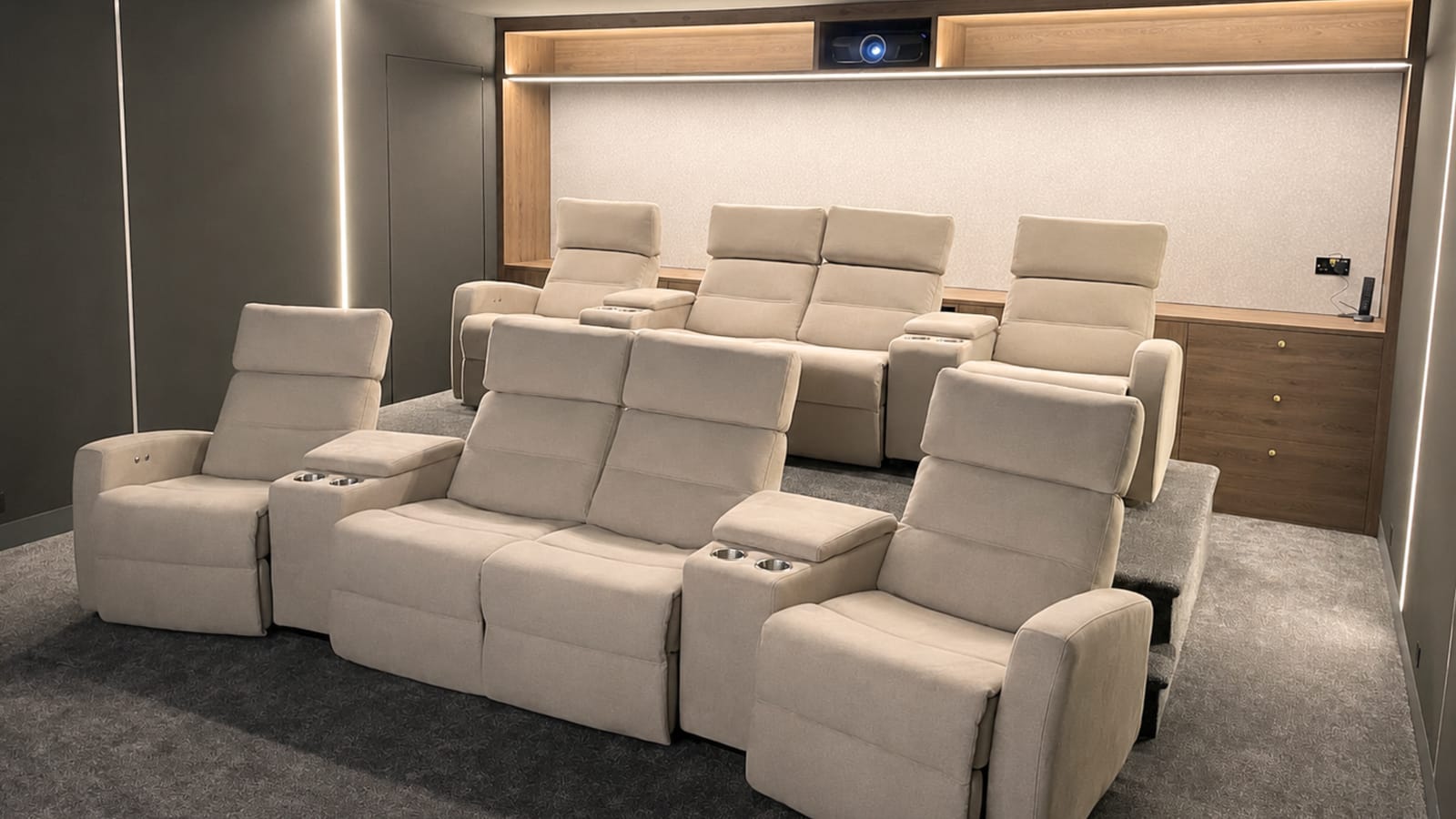
[ from the screen looking back at two rows of recliners, rear row on a riser. seating is the subject, the room is the context ]
The core of it

Seating is a room decision, not a furniture one.

Furniture retailers sell cinema seating as a product: pick a style, pick a colour, pick the number of seats, add to basket. That works perfectly well if you are furnishing a room that is already built. It misses the point if you are designing a cinema.

In a properly designed cinema the seating position comes first. The primary row sets the reference viewing distance, which determines the screen size. It sets ear height, which determines speaker placement. It sets the rear-row position, which determines whether you need a riser and how tall it should be. Every one of those decisions flows from where people sit.

Choose the seating last and you inherit whatever the room allows. Choose it first and the room is built around the experience. That is the difference between a cinema that works and a living room with nice chairs in it.

The options

Five options, and what each suits.

From using what you already own to fully bespoke seating. The right one depends on the room, how you use it, and who is sitting in it.

Use what you already own

Not every cinema needs new seating. If your room already has comfortable seating in a reasonable position, the budget is usually better spent on the screen, the audio or the acoustic treatment. We will tell you honestly when your existing furniture is good enough, and where moving it improves sightlines and sound.

Best for: Budget-conscious projects, rooms with good existing seating, where the spend belongs elsewhere.

Cinema sofa

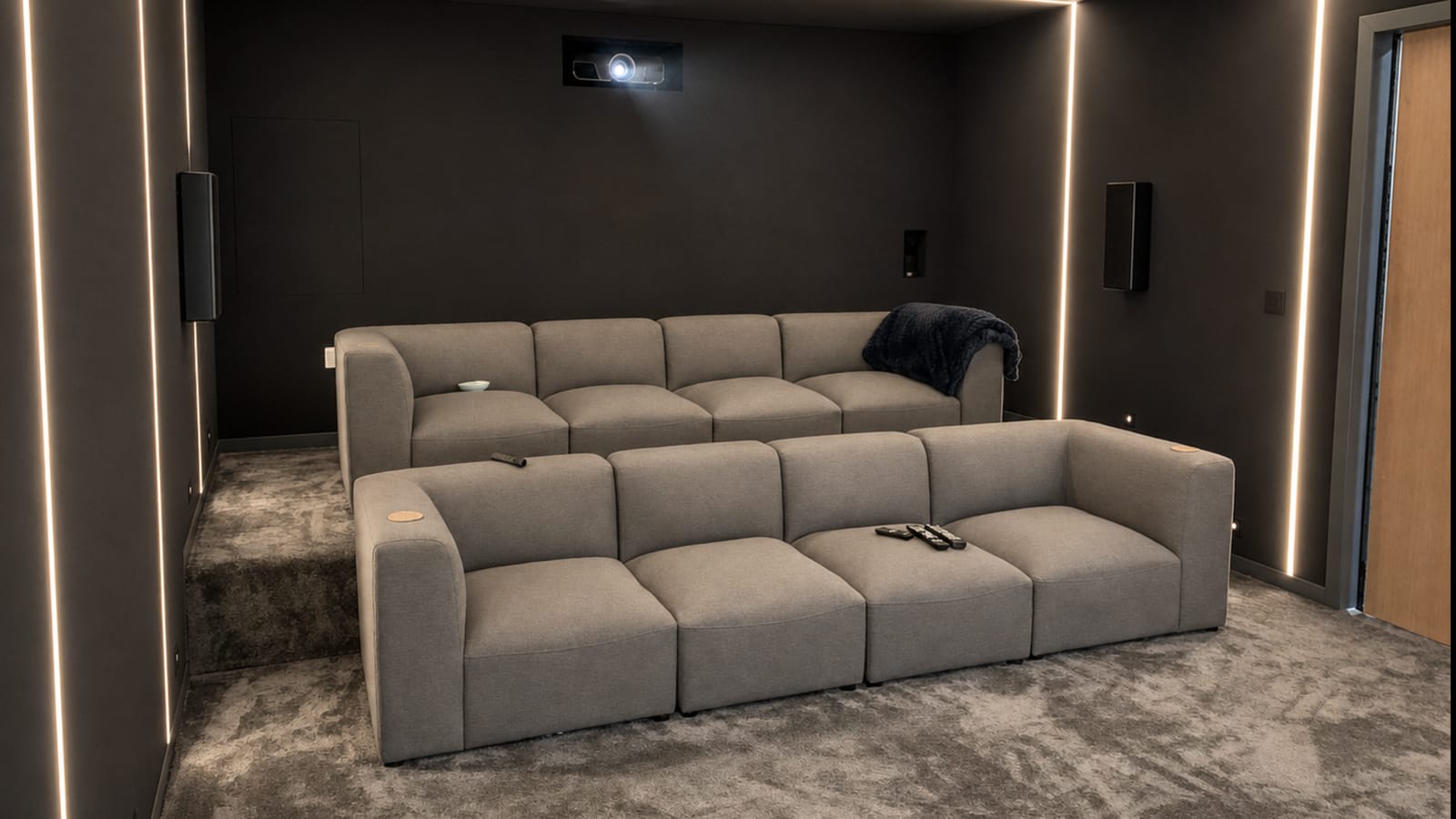
Comfortable sectional seating, typically three to four seats, with reclining options and a choice of fabric or leather. The most flexible and family-friendly option, and the easiest to live with day to day.

Best for: Family rooms, living-room cinemas, everyday use as well as film nights.

Individual recliners

Personal cinema recliners configured per seat, with powered recline, LED cup holders, and the freedom to set exactly how many seats you want and how they are spaced. The most cinema-authentic option for a dedicated room, and the most configurable.

Best for: Dedicated cinema rooms, per-seat comfort, the authentic cinema feel.

Theatre row seating

An authentic cinema row: three to four seats in a fixed configuration, with a choice of styles, colours and fabrics, and premium upholstery throughout. The choice when the goal is to recreate the commercial cinema as faithfully as possible, especially across tiered rows on a riser.

Best for: Dedicated rooms, larger groups, the full cinema recreation.

Custom seating design

Bespoke seating designed and built for the specific room, with bespoke detailing, the finest materials, and options including heated seats and massage function. The choice where the seating is part of the interior design rather than a catalogue selection.

Best for: High-performance and Premium Suite cinemas, design-led projects, rooms with unusual geometry.

The design work

The seating plan is the room plan.

Four decisions a furniture purchase never accounts for, and that make the difference between comfortable and compromised.

[ section drawing: viewing distance, sightlines over a riser, row spacing ]
01

Viewing distance

The primary row should sit far enough back that the image fills your field of view without straining your eyes. As a rough guide the main seats sit between 1.5 and 2.5 times the screen width from the screen, though the exact distance depends on screen size, resolution and what you watch most. Too close and the image is overwhelming. Too far and you lose the cinema feel.

02

Sightlines

Everyone should see the whole screen without craning or peering over the row in front. With one row that is straightforward. With two it means raising the rear row on a riser. The height is calculated from the seat heights, the screen height and the row spacing, not guessed.

03

Row spacing and walkways

Enough space between rows for legroom and for people to pass without disturbing a reclined seat, and enough at the sides or rear for access. Recliners need clearance behind them to recline fully, and a rear row pushed too close to the back wall is one of the most common mistakes we are asked to fix.

04

The riser

With two rows the rear row almost always needs one. A riser is not a step, it is a built platform, often with integrated lighting and sometimes with the rear speakers and cabling routed through it. It is part of the room build, which is exactly why seating has to be planned before the room is finished.

Seat count

How many seats, and how to lay them out.

A rough guide to what a room comfortably holds. The final layout always depends on the specific room.

Room size Comfortable seats Typical layout
Small, around 11 sqm 2 to 4 Single row, cinema sofa or two to three recliners
Medium, around 17 sqm 4 to 6 Single row of recliners, or a sofa plus two chairs
Large, around 27 sqm 6 to 8 Two rows, rear row on a riser
Extra large, 41 sqm and above 8 to 12 Two or three tiered rows, theatre style
A well-laid-out four-seat room beats a cramped six-seat one every time.

More seats is not always better. A row crammed to capacity leaves no room for recline, walkways or side tables, and pushes the rear row too far back. We plan seat count against comfort and sightlines, not against the maximum the floor area allows.

The practical choices

Once the plan is right.

Recline

Powered recline is standard on dedicated cinema seating, moving the backrest and footrest independently. Manual recline costs less but is less precise. Wall-hugger designs recline forward rather than back, which helps where space behind the seat is tight.

Materials

Leather is the cinema-authentic choice: durable, easy to clean, and it ages well. Fabric is warmer and quieter, and it absorbs sound rather than reflecting it, which helps acoustically, but it needs more care. On bespoke projects the upholstery is chosen with the interior designer to match the room.

Features

Integrated cup holders, powered USB charging, storage arms, lap lighting for finding your seat in the dark, and seat-position memory on premium models. Headrests and lumbar adjustment matter more than people expect across a two-hour film. Heated seats appear at the top of the range.

Build quality

Cinema seating is used heavily and reclined constantly, and the mechanism is the part that fails first on cheap seating. A good frame and mechanism is worth more than a long feature list. A well-built seat with no cup holder outlasts a feature-packed one with a weak recliner.

The link most people miss

Your seats are acoustic surfaces.

Seating is part of the acoustic design of a cinema, not separate from it. Large leather seats are reflective. Fabric seats absorb. A room full of leather recliners behaves differently to the same room with fabric seating, and a good design accounts for that when planning acoustic treatment. The seats are furniture you sit on and surfaces the sound bounces off, at the same time.

This is why seating has to be settled before the acoustic treatment is specified. Decide it once the panels are already on the walls and the treatment is correcting for a room that no longer exists. A furniture retailer cannot account for this, because they never see the room.

Seat position matters acoustically too. The primary listening position should sit at the acoustic sweet spot, where speaker placement and bass response are optimised. If the seating plan and the speaker plan are designed separately, the best seat in the house can end up in the worst sounding spot. Designing them together is the whole point of treating seating as part of the room.

Budget

Where seating sits in a cinema budget.

Seating spans a wide range, from keeping what you already own to bespoke seating with heated and massage functions. These ranges give you a sense of scale. The exact figure depends on your room, the build tier and how you will use the space, and comes as part of your cinema proposal.

Cinema sofa
from ~£1,500
per sofa
Individual recliners
from ~£800
per seat
Cinema row
from ~£3,000
per row
Bespoke
from ~£15,000
per row

Keeping the seating you already have costs nothing, and is often the right answer. It is covered in the options above rather than priced here.

What drives the cost: the type of seating, the number of seats and rows, the tier of build and finish, the features, and whether a riser is needed and how it is built and lit.

We will tell you when a less expensive option is the right one, when your existing furniture is good enough, or when the money is better spent on the screen or the audio than on heated massage seats. The goal is the best room for your budget, not the most expensive seating we can sell.

Our approach

Designed into the room, not ordered at the end.

We plan seating at design stage

Seating position is one of the first things we fix, because so much else depends on it. The seating plan is part of the room design document, alongside speaker placement, screen geometry and acoustic treatment.

We design the riser and sightlines

Where a second row is needed we calculate and build the riser to the correct height, with integrated lighting and any cabling routed through it. The back row sees over the front, every time.

We specify to the room, not to a brand

We are not tied to a single seating brand. We specify what suits the project, whether that is a sofa, recliners, a theatre row or bespoke, and integrate it with the acoustic and lighting design. On bespoke projects we coordinate the seating finish with the room's joinery and materials, the same way we do with our own speakers, so the seating belongs to the room rather than sitting in it.

We think about the whole experience

Comfort across the length of a film, sightlines from every seat, the acoustic role of the seating, and how it looks in the finished room. Because the recline mechanism works hardest, every seating installation carries our 12-month complimentary warranty, with support on hand once the room is in everyday use.

Frequently asked

Cinema seating: quick answers.

How much does home cinema seating cost?
Home cinema seating spans a wide range. As a rough guide, a cinema sofa runs from around £1,500 to £7,000, individual recliners from around £800 to £3,000 per seat, theatre row seating from around £3,000 to £10,000 per three to four seat row, and fully bespoke seating from around £15,000 to £30,000 or more per row. The figure within each range depends on the build tier, materials, seat count and features. Because we design seating into the room rather than sell it off a shelf, we give an exact itemised cost as part of your cinema proposal.
How far should home cinema seats be from the screen?
As a rough guide the primary seating row should sit between 1.5 and 2.5 times the screen width from the screen. For a 120-inch screen, roughly 2.6 metres wide, that places the main seats around 4 to 6.5 metres back. The ideal distance depends on screen size, resolution and the content watched most. Sitting too close makes the image overwhelming; too far loses the cinema feel.
Do I need a riser for a second row of cinema seats?
Almost always, yes. A riser raises the rear row so the back seats see the whole screen over the heads of the front row. The height is calculated from the seat heights, the screen height and the spacing between rows, so it is not a standard measurement. A riser is a built platform, often with integrated step lighting and cabling routed through it, which is why seating needs to be planned before the room is finished.
What is the best type of seating for a home cinema?
It depends on the room and how it is used. A cinema sofa suits family and living-room cinemas used for everyday viewing. Individual powered recliners suit dedicated rooms and give the most authentic per-seat cinema feel. Theatre-style rows suit larger dedicated rooms recreating the commercial cinema experience. Bespoke seating suits high-performance and Premium Suite cinemas where the seating is part of the interior design.
How many seats fit in a home cinema?
A small cinema room of around 11 square metres comfortably seats two to four. A medium room of around 17 square metres seats four to six in a single row. A large room of around 27 square metres seats six to eight across two rows. Extra-large rooms of 41 square metres and above seat eight to twelve in two or three tiered rows. Comfort and sightlines matter more than maximum capacity: a well-spaced four-seat room beats a cramped six-seat one.
Leather or fabric for cinema seating?
Leather is the cinema-authentic choice: durable, easy to clean and hard-wearing. Fabric is warmer, quieter and acoustically helpful because it absorbs sound rather than reflecting it, but it needs more care. The choice affects the room acoustically as well as aesthetically, which is one reason seating should be considered as part of the cinema design rather than chosen separately.
Can you supply seating if I have already built my cinema?
Yes, though the best results come from planning seating before the room is finished. If your room is already built we can advise on the seating that works within the constraints you have, position it for the best sightlines and sound the room allows, and supply and install it. If you are still planning the room, we would design the seating in from the start, which usually produces a better and often more cost-effective result.

Plan your cinema seating properly.

The best way to choose cinema seating is to sit in it, and to plan it as part of the room. Our showroom has cinema seating set up in working cinema rooms, so you can see how it sits in context rather than on a shop floor. Book a visit, or request a consultation and we will plan the seating into your room from the start.

Acoustic Pixel Ltd · Unit 7, Mandale Park, Cannon Street, Middlesbrough, TS1 5AJ · 01642 903907