
SDR reference
BT.709 / Rec.709
D65 white point, 2.2 or 2.4 gamma curve, Rec.709 colour gamut. The standard against which all SDR Blu-ray, broadcast and streaming content is mastered.
Why home cinema calibration matters, and why every cinema we build is calibrated to commercial cinema standards before we hand it over.
Most premium home displays leave the factory in showroom mode: punchy, oversaturated, set for fluorescent retail lighting rather than for the way you actually watch films. Video calibration is the process of adjusting the display against measurement equipment and industry standards so the image matches what the film-makers approved.
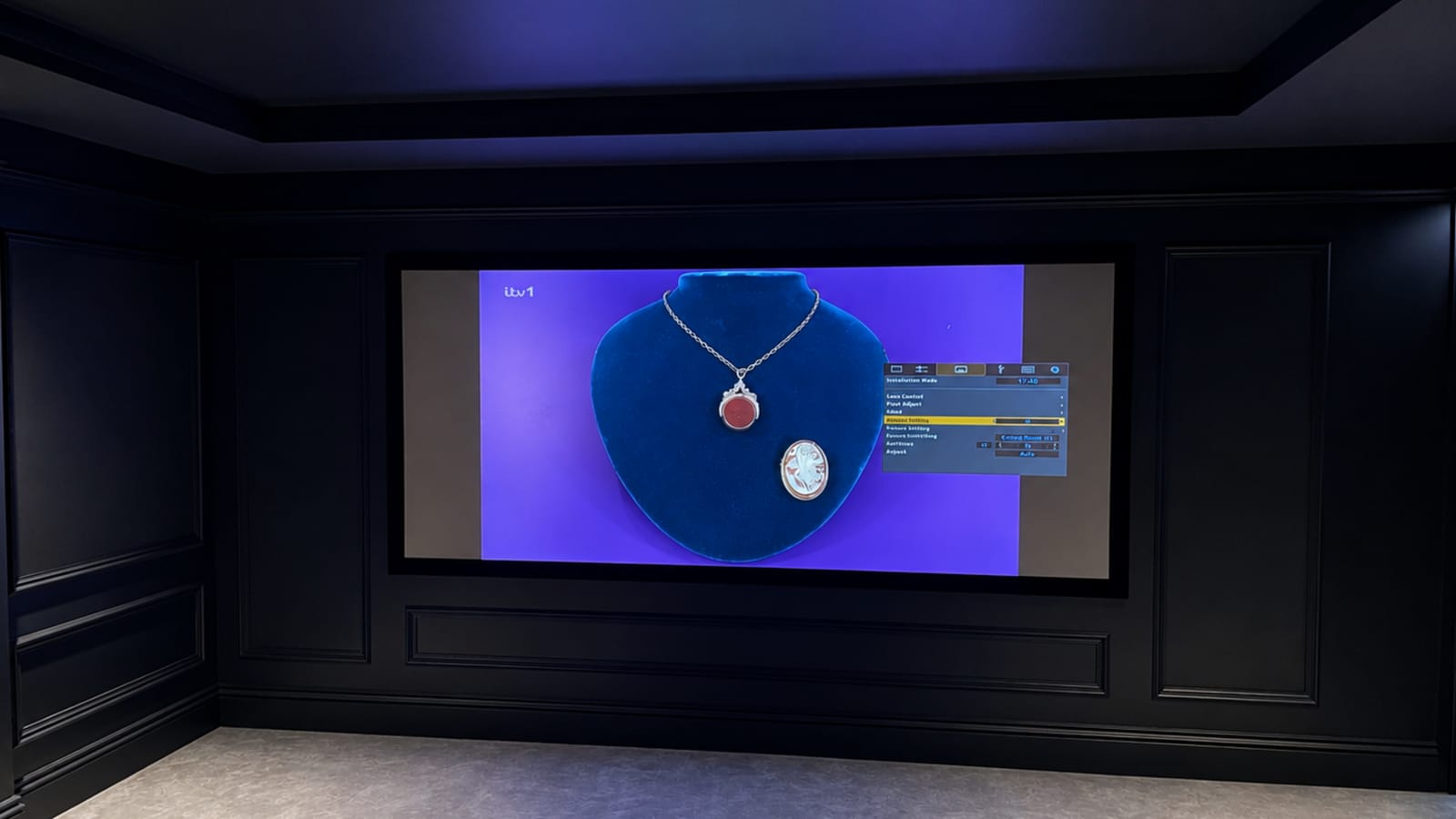
Out of the box, even the best projectors and TVs are tuned for the lighting of a brightly lit showroom and the preferences of a casual viewer. Contrast is pushed. Saturation is exaggerated. This works on a shop floor. It doesn't work in a properly designed home cinema.
Calibration measures the display's actual output against a reference standard, then adjusts every setting until the image matches what the film was mastered against. It's measurement, not preference.
Calibration is a measurement exercise. A colorimeter and pattern generator measure the display's actual output across colour, contrast, gamma and HDR performance. Results are compared against industry reference standards, the same ones used in commercial cinema mastering, and adjustments made until the display tracks within tolerance.
D65 white point, 2.2 or 2.4 gamma curve, Rec.709 colour gamut. The standard against which all SDR Blu-ray, broadcast and streaming content is mastered.
DCI-P3 colour points within a Rec.2020 container, PQ electro-optical transfer function for HDR10. Tone-mapping verified against your display's actual peak brightness.
Reference-grade colorimeter mounted to the screen, pattern generator driving test signals through your actual source chain. Greyscale tracking, colour points, gamma curve and luminance all measured.
Service-menu adjustments where required, then settings stored to specific picture mode profiles (ISF Day and ISF Night on supporting displays). Two profiles minimum: one for day viewing, one for night.
Calibration genuinely changes the picture in some contexts. Less so in others. We'd rather you trusted our advice on the rooms where it transforms the picture.
A premium dedicated cinema delivers a fraction of its potential without calibration. The cost is small relative to the build. The performance gap is large.
Projectors drift more than TVs. They benefit most from calibration both at install and as a periodic check-up.
Reference-grade TVs benefit from calibration for accurate skin tones, HDR tone-mapping and shadow detail.
The picture won't change enough to notice. We'll dial in a sensible mode at install. Calibration isn't the upgrade that moves the needle here.
Calibration isn't a separate appointment. It's a stage in how we deliver every cinema: built in at design, set up during install, signed off at handover by THX-trained calibrators, with the room's measurements documented in a report you keep.
Projector, screen and room specified around the picture you'll see, not the spec sheet.
Mounting, screen tensioning, ambient light control, so the calibration session starts from the right baseline.
Two to four hours, measurement-led. Detailed below.
Recommended for projector-based cinemas: laser drifts in its first 1,000 hours. On request for existing clients.
Where the display currently sits across colour, contrast, gamma and HDR.
Light levels, screen geometry, viewing distance, ambient reflections.
D65, gamma, primary and secondary colours to BT.709 / Rec.709.
HDR10 and Dolby Vision. Tone-mapping verified against peak brightness.
Final measurement run, modes stored, customer walkthrough, report delivered.
The result: calibration is never the part of the project that doesn't happen. Every cinema we hand over has been measured.
Five things change. The first is the only one most viewers consciously notice. The other four are the reason it happens.
Greyscale tracking aligns the display to the standard cinematographers grade against. Faces stop looking sunburnt, yellow, or vampire-pale.
Gamma and black-level alignment recover shadow detail already in the signal. The image gains depth, not density.
Colour points measured to Rec.709 (SDR) or DCI-P3 / Rec.2020 (HDR). The reds in the film are the reds in the film.
Tone-mapping verified against your display's peak brightness. Highlights stop blowing out. Shadows stop disappearing.
Calibrated settings stored to specific picture mode profiles. You stop tweaking. The display works.
Audio is the other half of the handover. Read about audio calibration →
If you're planning a home cinema, calibration is one of the reasons buyers come back to us for follow-up projects years later, and one of the reasons the rooms we build outperform the budgets they were built to.