
Garden speakers: what works outdoors and what it costs
Garden speakers range from a pair of weatherproof wall speakers over a patio to a hidden system of small speakers in the borders with a buried subwoofer. Which one you need depends on the size of the space, how you use it and whether the cables can go in before the landscaping does.
By Stephen, Director · 18 November 2026
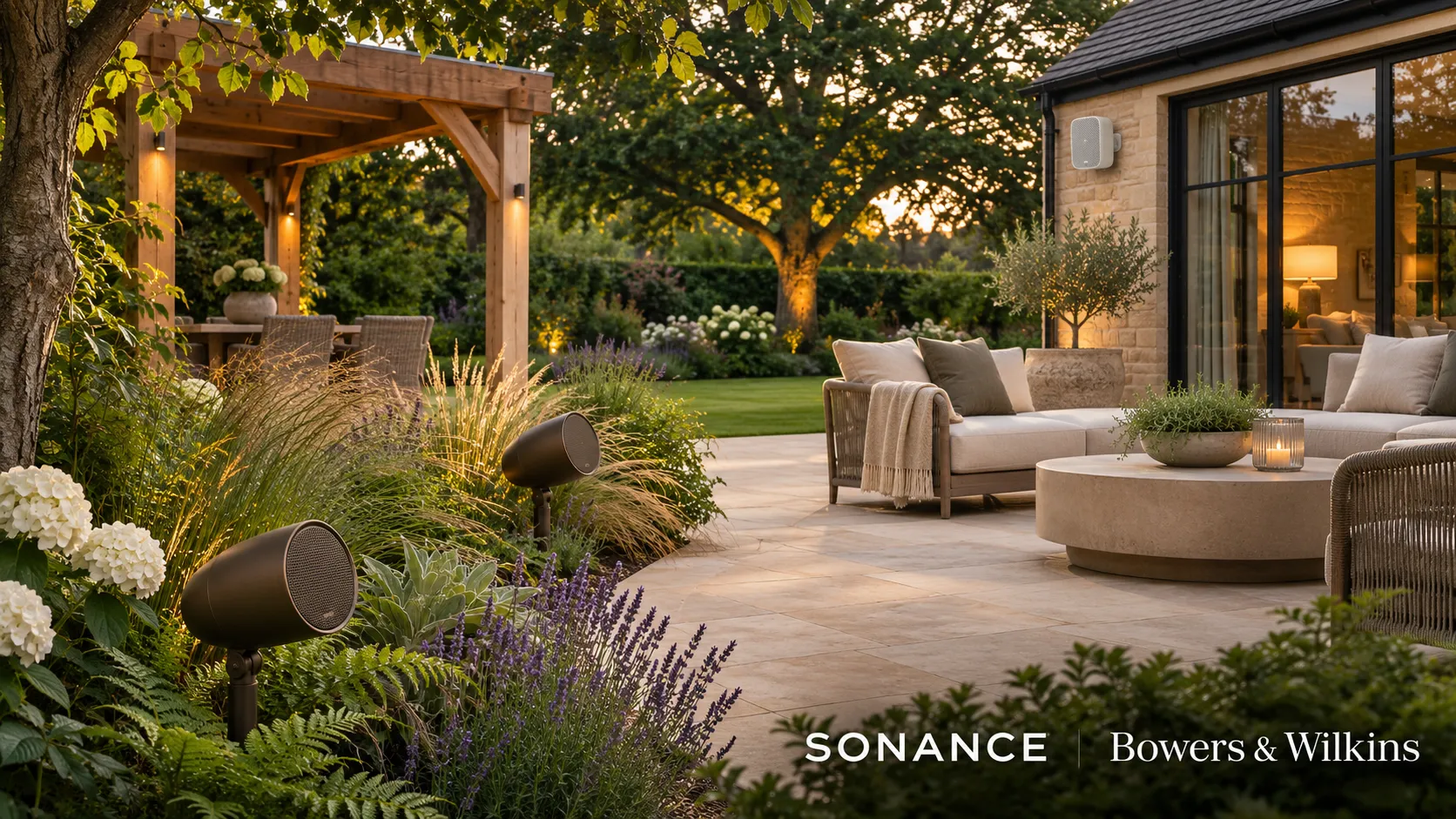
In the UK, we all love those warm summer days and evenings when we can relax in the garden. In fact, more of us are spending an increasing amount of time out there - all year round! This time is only enhanced by great quality music. Let’s talk garden audio!
While portable Bluetooth speakers are a nice and easy way of taking music outside, they have their limitations. Our garden audio installations feature permanent, weatherproof speakers fixed to a wall, set among the planting or sunk into the ground, and often connected from the same system as the music indoors.
This guide covers the main types of garden audio systems; how many you need, how they are wired, what survives a British winter and what drives the cost.
Portable speaker or something wired in?
A portable Bluetooth speaker is the cheapest way to get music outside, and for the odd summer evening it may be all you need. Its limits show quickly. One speaker loud enough to reach the end of the lawn is far too loud on the patio. The battery runs down, the connection drops when your phone goes back indoors, and someone has to carry it in when it rains.
A fixed system solves those problems by spreading the sound across several smaller speakers, each playing at a modest level, and by running from the house rather than from a phone in someone’s pocket. Of course it costs more and it needs planning, which is why most of this article is about getting the plan right.
The main kinds of garden speaker
Type | Where it suits | What to know |
|---|---|---|
Wall-mounted weatherproof speakers | Patios, terraces, under the eaves | The simplest route. Fixed to a structure, aimed across the seating, and often easy to cable from inside. Often available in paintable finishes. |
Rock and planter speakers | Borders, beds, a seating area or hot tub away from the house | Shaped to sit in the planting. Placement among real plants does more for the disguise than the shape does. |
In-ground and bollard satellites with a buried subwoofer | Large gardens, long lawns and borders | Several small speakers spread around the garden, with the subwoofer buried. The most even sound and the least visible kit, and the most cabling. |
Plenty of gardens mix them: a pair of wall speakers over the terrace for everyday listening, and a few satellites down the borders for the days the whole garden is in use. Our outdoor audio page shows how the three approaches fit together.
How many garden speakers do you need?
Indoors, the walls and ceiling reflect sound back at you. Outside there is nothing to contain it, so it falls away quickly with distance. That is why one large speaker fails in a garden: to be heard at the far end it has to be uncomfortably loud close to.
The fix is more speakers, each doing less. As a rough guide:
-
A small patio or terrace: two speakers as a stereo pair, mounted on the house wall and angled across the seating.
-
A larger terrace, or one that wraps round a corner of the house: four, so nobody is sitting right next to one speaker and far from the rest. Satellites will give more even coverage.
-
A garden you use end to end: satellites spaced around the edges of the areas you actually sit in, with a buried subwoofer to fill out the bass at low volume.
Spread the sound where people gather, not where they rarely go. A lawn you walk across twice a year does not need its own speaker.
Keeping the neighbours on side
A designed system is quieter at the boundary than a single loud speaker, for two reasons. Each speaker plays at a lower level, and we aim them inward, from the edges towards the house and the seating, rather than outward at the fence. Bass is the part that carries furthest and passes most easily through fences and hedges, so a subwoofer should be set to fill out the sound at a gentle level, not to be felt three gardens away. Beyond that, the rule is simple: be considerate about the volume and the time of day.
How garden speakers are powered and wired
Most garden speakers are passive, which means they have no power supply of their own. They take a speaker cable from an amplifier indoors, usually in a cupboard, a utility room or the equipment rack that runs the rest of the house. No mains power is needed in the garden itself.
-
Wall speakers are the easy case: the cable goes through the wall behind the speaker, or along the eaves, to the amplifier inside.
-
Landscape speakers need cable runs across the garden. These are laid in a trench, either as cable rated for direct burial or inside ducting, deep enough and routed so that a spade or a lawn edger will not find them.
-
Larger systems with many speakers or long runs need thicker cable and an amplifier sized for the load.
-
Powered or wireless outdoor speakers do exist, but they need a mains supply outside. That means outdoor sockets or fused connections fitted by a qualified electrician, and good Wi-Fi coverage in the garden if they stream over the network.
The single most useful thing you can do is plan the cable runs before the landscaping goes in. We do this on every garden audio system we design: trenching across a finished lawn, under a new patio or through established planting is where the cost and the disruption grow. If you are not ready to buy speakers yet, ask your landscaper to lay ducting with a draw cord to the places speakers might go. It costs little while the ground is open and saves a great deal later.
What survives a UK winter
Outdoor speakers carry an IP rating. The first digit covers dust and solid objects, the second covers water. Speakers sold for outdoor use typically sit somewhere between IPX4, protected against splashing from any direction, and IP66 or IP67, which cover powerful jets of water and brief immersion.
An IP rating tells you about water. It says nothing about frost, sunlight or salt, and those are what finish off cheaper outdoor kit after a season or two.
Some speakers marketed as outdoor are only meant for sheltered spots under a canopy. Check specifically what the manufacturer says about suitability for permanent installation in the open.
One app for the house and the garden
Garden speakers work best as one more zone of your home’s audio rather than a separate system with its own control. Set up that way, you can play the same music inside and out as you walk through the doors, play something different on the terrace, or turn the garden down from your phone without going outside. Our guide to multi-room audio with Sonos or Control4 explains how the zones are put together, and the multi-room audio page covers the system indoors. Tied into a smart home, one evening scene can bring up the garden lighting and start the music together.
What garden speakers cost
The cost of an outdoor system is driven by a few things, roughly in this order: the groundwork and cable runs, the number of speakers, whether a subwoofer is involved, and whether the garden becomes a new zone on a system you already have or needs its own amplification and streaming.
Approach | Typical scope | Indicative cost |
|---|---|---|
Wall-mounted pair over a patio | Two speakers, cabled through the wall to an amplifier zone indoors | From £800 |
Rock or planter speakers | Two to four speakers in the borders, short buried runs | From £800 |
Landscape system with buried subwoofer | Several satellites around the garden, a subwoofer and longer trenched runs | From £2000 |
Every garden is different, so ask us for a quote based on yours. If the garden is being landscaped anyway, the groundwork costs far less than it would in a finished garden.
What you probably do not need
A small patio does not need a landscape system. Two good wall speakers, properly placed, will sound better than a ring of cheaper ones. A buried subwoofer only earns its place in a large garden where you want full sound at a low level across a wide area. You do not need speakers in parts of the garden you never sit in, and you do not need high power ratings: several speakers at a modest level always beat one pushed hard. The wider range of what we install is on our AV solutions page.
If you are planning a garden, or the landscaping is about to start, talk to us before the ground is closed up. Call 01642 903907, or come and see us at the Middlesbrough showroom with a plan or a few photos of the garden, and we will work out where the speakers and the cables should go. Or why don’t we come to you? Let us bring a sensational garden audio system to your garden and experience it yourself!
Quick answers.
- How many speakers do I need for a garden?
- A small patio or terrace is usually well served by two speakers as a stereo pair on the house wall. A larger terrace may need four, and a garden you use end to end needs satellites around the seating areas plus a buried subwoofer. More speakers at a lower level always sound more even than one loud one.
- Can garden speakers stay outside all winter?
- Yes, if they are made for permanent outdoor installation. Check the IP rating for water protection, but also look for UV-stable housings, stainless or coated fixings and sealed connections. Near the coast, choose speakers specified for salt air.
- Do garden speakers need a power supply outside?
- Most do not. Passive garden speakers take a speaker cable from an amplifier indoors, so no mains power is needed in the garden. Powered or wireless outdoor speakers do need outdoor sockets or fused connections, fitted by a qualified electrician.
- Will a garden sound system annoy the neighbours?
- A designed system should be quieter at the boundary than a single portable speaker. Several speakers at a modest level, aimed inward towards the house and seating, carry far less over the fence. Keep the bass gentle, since it travels furthest, and be considerate about volume and the time of day.
- Can I play the same music in the house and the garden?
- Yes. Set up as a zone of a whole-home audio system, the garden can play the same music as the rooms inside or something different, all from one app. You can also turn the garden down from your phone without going outside.
Stephen
Director
Similar articles.
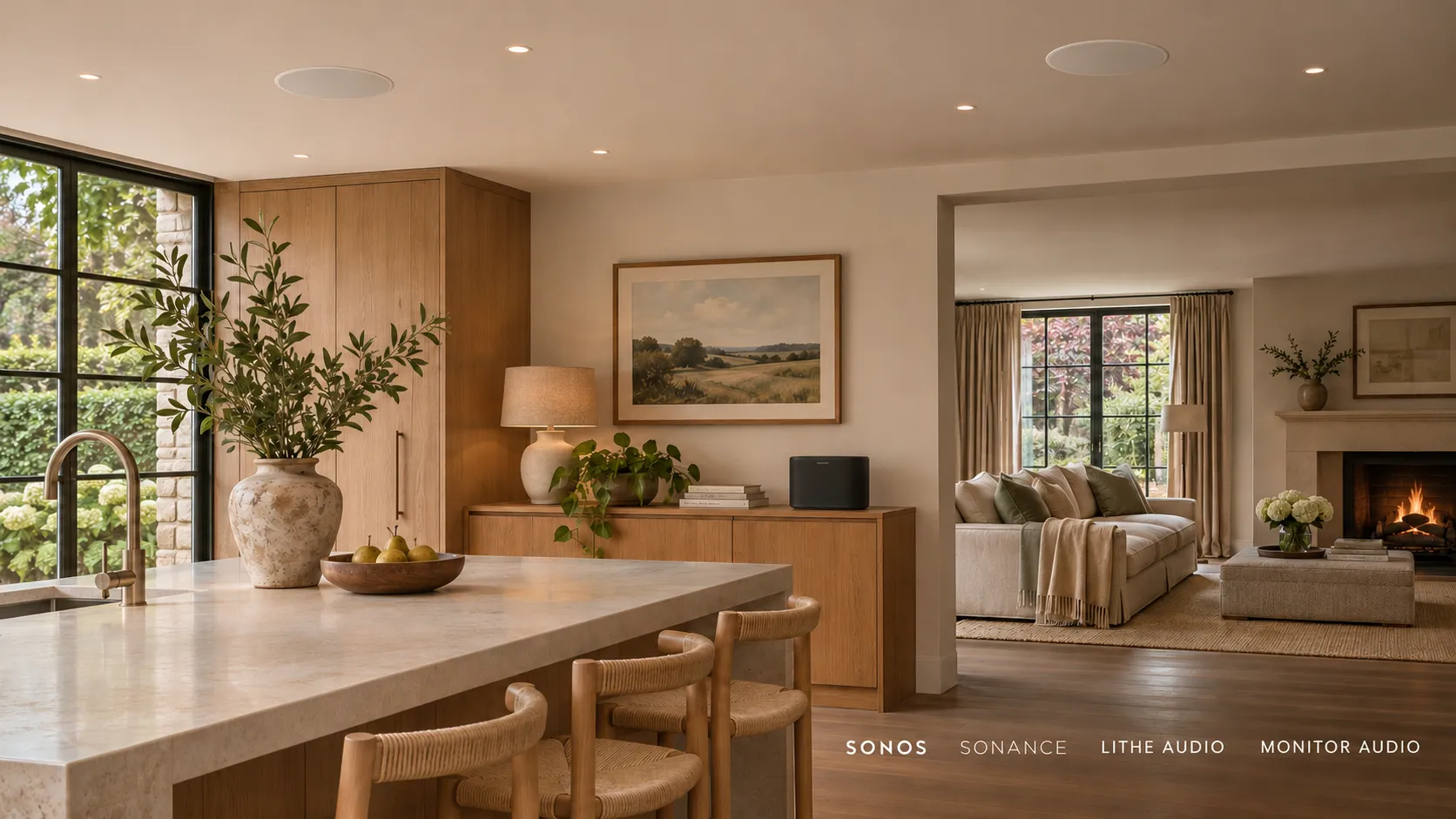 Multi-Room AV · 6 min read
Home audio installation: what it involves and what it costs
A home audio installation puts speakers into your ceilings, walls or garden, runs them from one system and one app, and plans the cabling so nothing shows. Here is what the job involves, when to do it and what drives the cost.
Read article →- Multi-Room AV · 6 min read
Multi-room audio: Sonos or Control4?
Three sensible ways to get music into every room, and which one fits which kind of project.
Read article → 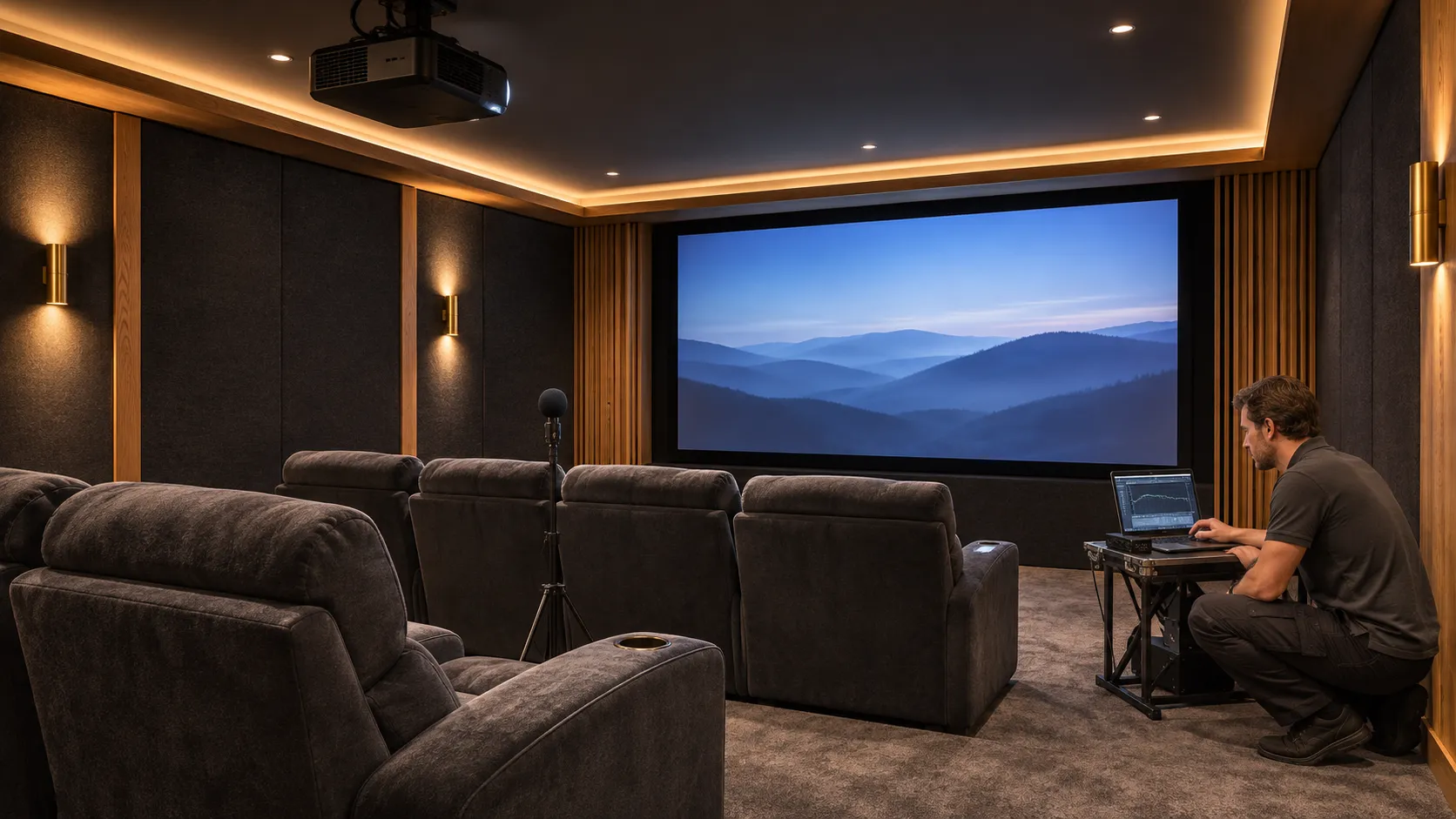 Home cinema · 7 min read
Home cinema installation: what happens, stage by stage
A home cinema installation runs in six stages: survey, design, first fix, the room build, second fix and calibration. Here is what happens at each one, which trades are involved and what you need to decide before anyone arrives.
Read article →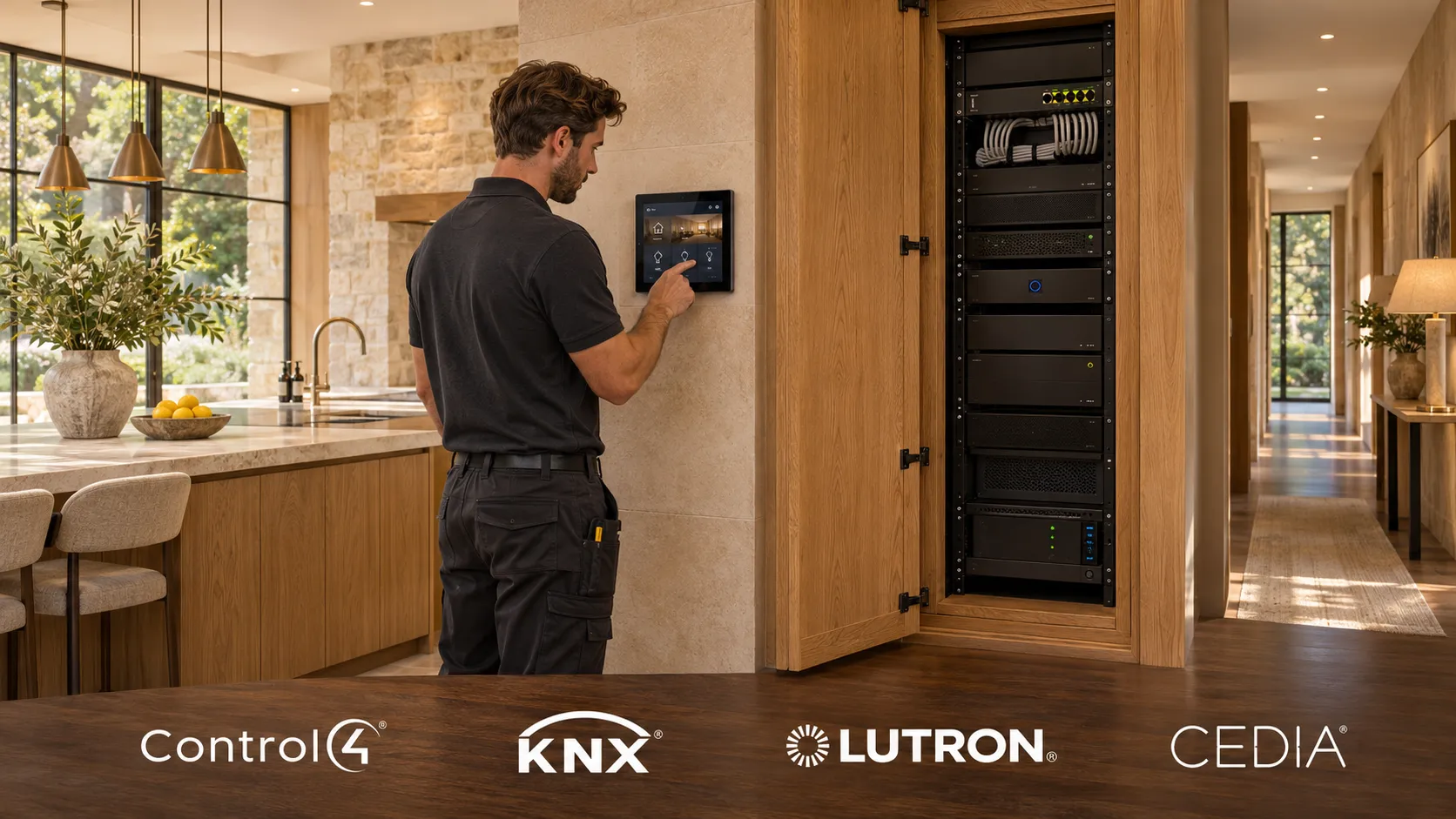 Smart home · 6 min read
Smart home installation: what happens and in what order
A smart home installation is a network, a control platform and the devices in each room, designed first, cabled at first fix, fitted at second fix and then programmed around how you live. Here is what each stage involves, how it fits around a build or renovation, and what drives the cost.
Read article → Smart home · 6 min read
Automated blinds: what they cost and what to automate
Automated blinds are ordinary blinds or curtains with a quiet motor, run from a keypad, an app or a schedule, on their own or as part of a smart home. Here is what can be motorised, what moves the price, and which windows are actually worth it.
Read article → Home cinema · 5 min read
How to build a home cinema room: a step-by-step guide [2026]
Turning planning into a cinema that actually works - nine decisions, in the order that keeps compromises out of the room.
Read article →
Talk it through with a designer.
Price a room with the calculator, read more about multi-room av, or come and hear the difference in the showroom.